Infinity Kingdom
- 4.5
- Rating
- 5.00M
- Installs
- Free
- Price

 Analysis by App-foxy
I spent time with Infinity Kingdom as a strategy player looking for something that could fill short sessions without feeling completely empty after the first few minutes. It presents itself as a cartoon-styled MMO strategy game, but that description only tells you the surface. The real appeal is the steady chain of goals: building up your position, making choices about your forces, and checking whether a better plan can carry you further than the last one.
My first impression was that it wants to be both approachable and demanding. The colorful presentation makes the game look lighter than many serious strategy titles, while the long-term structure asks for patience. You are not simply tapping through battles and moving on. The important decisions come from deciding what deserves attention now, what can wait, and how much time or spending you are willing to put into faster progress.
That balance makes it interesting, but it also creates the main question I would ask before recommending it: do you enjoy a game that keeps giving you something to improve, even when the improvement is gradual? If yes, this has a good chance of holding your attention. If you want a self-contained strategy campaign with a clear ending, it may feel too persistent and too dependent on returning regularly.
You May Also Like

 Blood Strike: 2.5 Anniversary
Blood Strike’s Loadouts Turn Every Drop Into a Tactical Gamble
A close look at Blood Strike’s custom loadouts: how fast access to signature weapons reshapes its battle royale rhythm, rewards preparation, and narrows the gap between fights.

 Pandora - Music & Podcasts
Pandora’s Music Is Easy to Start, but Harder to Recover
Pandora’s strength is its low-effort path from a seed to a station. Its weak spot is how much confidence it asks you to place in connection, setup, and quiet recovery.

 8 Ball Pool
 Is Built on Rivalries, Rematches, and Routine
A close look at the rivalries, rematches, shared routines, and unanswered safety questions that turn a quick pool match into a persistent mobile community.

 Samsung Music
’s Quiet Strength Is Playing What You Already Own
Its reach comes less from spectacle than from dependable access to a personal library. That simplicity is both the app’s strongest retention engine and its ceiling.

 AccuWeather: Weather Radar
AccuWeather Review: A Quick, Clear Forecast for Everyday Decisions
For everyday plans, the best forecast is the one you can understand quickly. AccuWeather makes rain timing, radar, and local conditions easy to act on, with a few trade-offs.

 Hill Climb Racing
Why Hill Climb Racing Still Turns Crashes Into One More Run
A tiny car, a bumpy hill and one more upgrade: Hill Climb Racing keeps resurfacing because its simple chaos makes every near-miss feel personal.
More From Our News Desk



How the first goals shape the experience
The opening works best when I treated it as a guided setup rather than a test of strategic mastery. Early tasks give the game a rhythm: complete an objective, improve the settlement or army, then use that improvement to reach the next objective. This structure is useful because it prevents the first session from becoming a confusing collection of menus.
I liked having immediate reasons to interact with the main systems. A new player can focus on the next practical step instead of trying to understand the entire game at once. That matters in a mobile strategy game, where a complicated first impression can make people quit before they discover the deeper choices. Infinity Kingdom keeps the initial direction visible enough that I rarely wondered what I was supposed to do next.
The early goals also teach an important habit: progress is rarely about one isolated action. Improving one part of your position only becomes valuable when it supports another part. A stronger force is more useful when it is matched with sensible preparation, and development choices matter more when they help you handle the next challenge rather than merely making a number look larger.
My advice is not to spend the opening hours trying to upgrade everything evenly. I found it more useful to identify the activities I enjoyed most and let those guide my early investment. If battles are the main attraction, prioritize the improvements that help you reach them confidently. If you prefer planning and development, use the early tasks to learn the economy of your position before chasing every available confrontation.
One less obvious strength is that the early loop gives you a safe place to notice how the game communicates priorities. Some objectives are there to move the story of your account forward, while others encourage broader development. Reading them as hints rather than chores makes the first phase more informative. I began to see which upgrades were genuinely helping my next goal and which ones were simply tempting distractions.
This is also where the cartoon presentation earns its place. The visuals make the opening feel less intimidating than a darker, more technical war game. I could spend time learning without feeling that every mistake had ruined the account. That does not mean the game stays simple, but the style lowers the barrier to entry for players who normally avoid MMO strategy games.
What progress feels like after the tutorial rhythm
Once the basic direction is clear, the satisfaction comes from visible progress rather than one dramatic unlock. I noticed several kinds of feedback working together: the state of my kingdom changes, my forces become more capable, and previously difficult tasks start to look manageable. None of these signals alone would carry the experience, but together they make short returns feel worthwhile.
The best sessions were not necessarily the longest ones. I could open the game with one practical intention, such as preparing for a challenge or improving a weak part of my setup, and leave after making a meaningful step. That makes it suitable for a daily routine, especially for someone who likes checking a strategy game during a commute, a lunch break, or a quiet moment in the evening.
A realistic example is a player who has fifteen minutes after work. Instead of trying to complete everything, that player can review the current objective, make one development decision, use available strength carefully, and stop before the session turns into aimless menu browsing. The next visit then starts with a clear purpose. I found that this approach made the game feel more controlled and reduced the pressure to remain connected for a long stretch.
The progress signals are strongest when they answer a specific question. Can I handle the next opponent? Is my current development choice helping my main force? Did the time spent improving one area open a better route forward? When the game gave me a clear answer, I felt engaged. When I was simply collecting small improvements without understanding their practical effect, the momentum weakened.
That distinction is important for new players. Do not judge the game only by how many upgrades appear on screen. Judge it by whether those upgrades change your decisions. If you are making more informed choices after each session, the progression is doing its job. If you are tapping through improvements without knowing why they matter, it is worth slowing down and choosing a narrower goal.
Infinity Kingdom also benefits from the feeling of an account that develops over time. The appeal is not just winning one encounter; it is building a position that gives you more options later. That long view will suit players who enjoy seeing a plan mature. It will frustrate anyone who expects every session to deliver a major new ability or a dramatic change in power.
Where the challenge rises and where patience matters
The difficulty curve is more about accumulated decisions than sudden reflex tests. Early tasks are forgiving enough to let you understand the structure, but later progress asks whether your earlier choices were sensible. A weak foundation can make the next stage feel unnecessarily slow, while a focused approach gives you more confidence when the game begins asking for stronger preparation.
I appreciated that the challenge encouraged planning rather than frantic input. The game is not at its best when I treated it like a quick arcade title. It rewards looking ahead, understanding what I am trying to accomplish, and avoiding wasteful actions. That makes the experience more thoughtful than the bright art style might suggest.
At the same time, the difficulty can feel uneven from a personal point of view. A player who checks in casually may reach a point where progress no longer feels as immediate as it did at the beginning. That does not necessarily mean the game has become unfair; it means the early guidance has given way to a longer-term test of commitment. The transition can be easy to miss, so I recommend expecting a slower pace rather than assuming every new stage will unlock at the same speed.
One practical tip is to keep a simple mental record of what stopped you. Was the problem insufficient development, poor preparation, or a choice that spread your attention too widely? Returning to the same obstacle without identifying the cause can make the game feel repetitive. I got more value when I used a failed attempt as information and changed one part of my approach before trying again.
Another useful trade-off is deciding when to improve breadth and when to improve depth. Broad development can make the account feel flexible, but it may delay the moment when one chosen direction becomes genuinely strong. Concentrating too heavily can create its own weakness. I would not follow a rigid universal formula here; I would choose based on whether my current problem was lack of options or lack of power in the option I already preferred.
This is where Infinity Kingdom differs from a purely casual strategy game. It can welcome a beginner, but it does not promise that the beginner will remain equally comfortable forever. The deeper loop asks you to learn from friction. Players who enjoy that kind of gradual problem-solving will probably see the rising difficulty as motivation. Players who want effortless progress should be cautious.
Daily momentum, waiting, and spending pressure
The game’s long-term design naturally creates a reason to return. Small improvements accumulate, unfinished objectives remain visible, and a developing kingdom feels more valuable when I check on it consistently. That creates a pleasant sense of continuity, but it also introduces retention pressure. I sometimes felt that the game was encouraging me to think about the next visit before I had fully finished the current one.
That pressure is not automatically a flaw. Many mobile strategy players want a persistent project rather than a game they complete in one weekend. The problem appears when regular engagement starts to feel like an obligation. If you dislike timers, repeated check-ins, or progress that feels better when managed frequently, the ongoing structure may become tiring.
Infinity Kingdom is free to download, which makes it easy to try without committing money at the start. It includes optional purchases ranging from $0.99 to $99.99 per item. That broad range is worth keeping in mind because the experience is not only about whether you can play for free; it is also about how comfortable you are ignoring offers while progress takes its normal course.
My recommendation is to decide your spending boundary before the game has a chance to turn impatience into a purchase. I would first play long enough to understand the normal rhythm of development. That makes it easier to tell the difference between an item that genuinely improves your enjoyment and one that merely removes a temporary annoyance. For a strategy game built around gradual progress, that distinction matters more than the presence of purchases by itself.
A useful everyday routine is to give the game a defined check-in window rather than opening it whenever a notification or unfinished task comes to mind. I found that setting a clear purpose helped me enjoy the planning without letting the game occupy every spare moment. It also made the slower parts easier to accept, because I was choosing the pace instead of reacting to it.
Players should also ask whether they enjoy persistent competition and account growth more than a traditional campaign. A premium strategy game with a fixed story may offer cleaner pacing and fewer reasons to return. A standard puzzle strategy game may deliver more immediate victories with less maintenance. Infinity Kingdom is the better fit when the ongoing development is itself the reward.
Who will get the most from the progression
I would recommend it to players who like cartoon presentation but still want meaningful strategic planning. It is especially suitable for someone who enjoys checking a developing account, making a few deliberate decisions, and watching those decisions affect later options. The MMO structure adds a sense that the kingdom is part of a larger, continuing world rather than a disposable level select screen.
It can also work for people who are new to this style of game, provided they are willing to let the opening guidance lead them. The early goals provide enough direction to begin, and the colorful design keeps the learning curve from feeling overly severe. I would encourage beginners to resist the urge to unlock or improve everything at once. A focused account is easier to understand than a scattered one.
On the other hand, I would not choose it for someone who wants a complete experience in short, independent chapters. The game’s strongest qualities depend on returning to the same developing project. It is also not ideal for players who dislike free-to-play economies on principle, even if they never spend. The presence of optional purchases can still affect how the pacing feels, particularly when patience and acceleration sit close together.
Age matters as well. The game is rated Everyone 10+, so it is aimed at a broad audience, but younger players may still need guidance around optional spending and the habit of frequent check-ins. The bright style should not be mistaken for a completely effortless experience. There is enough long-term planning here that a player benefits from understanding what they are choosing to prioritize.
On Android, the game requires at least version 6.0 of the operating system. Its current version is 2.9.0, and the developer is Yoozoo (Singapore) Pte. Ltd. Those details make it accessible to a wide range of Android devices, though the practical experience will still depend on how comfortably a particular phone handles a persistent, visually active strategy game.
How it compares with familiar strategy alternatives
Compared with a traditional turn-based strategy game, Infinity Kingdom places less emphasis on finishing a carefully bounded match and more on maintaining a growing account. A turn-based alternative is usually better when I want to pause between every decision, restart freely, or complete a scenario without worrying about long-term momentum. This game is better when I want my choices to continue mattering after I close it.
Compared with a simple city-building game, it offers a stronger sense of strategic pressure. A relaxed builder may be more comfortable for decorating, expanding, and watching numbers rise without serious resistance. Infinity Kingdom asks me to connect development with challenges, so the kingdom is not only a display of progress but also preparation for what comes next.
Compared with a competitive MMO strategy title aimed at experienced players, its cartoon presentation and guided opening make it less intimidating. However, the accessible entrance should not be confused with a shallow destination. The longer I played, the more important it became to understand trade-offs and manage my attention. That combination is its identity: friendly on the outside, persistent underneath.
The comparison also explains why some players will love it while others will leave quickly. It sits between a casual mobile routine and a more committed strategy hobby. If you want only a few minutes of instant action, another genre will serve you better. If you want a continuing project that rewards planning but remains approachable in presentation, this is a more convincing choice.
My verdict after following the longer loop
Infinity Kingdom succeeds because its goals, progress signals, and rising demands support one another. The opening gives me direction, the middle game makes improvement visible, and the later pace asks whether I am willing to plan rather than simply tap through tasks. That structure can sustain interest beyond the first impression, especially when I set my own priorities instead of chasing every available objective.
Its weaknesses are tied to the same design. Progress can become slower and more demanding, regular check-ins may feel like pressure, and optional purchases can make impatience more expensive. I would not describe those points as minor details for a player who prefers clean, finite games. They are central to deciding whether the experience feels rewarding or exhausting.
The strong store reception is understandable: it has a 4.6 average from around 257 thousand ratings, with over 5 million installs. Those figures do not replace personal preference, but they do reflect how broadly the formula has connected with mobile players. I can see why it has found an audience among people who want strategy wrapped in a bright, approachable world.
My final recommendation is straightforward. Try it if you enjoy long-term goals, gradual unlocks, and the satisfaction of making a developing kingdom more capable over time. Begin slowly, choose one clear direction, and decide your spending limit before the pressure to accelerate appears. Skip it if you want every session to end with a major victory or if persistent free-to-play progression makes games feel like chores.
For me, the game is most enjoyable when I treat it as a continuing strategy project rather than a quick distraction. Its best moments come from noticing that a choice made earlier has created a better option today. The progression is worth following when you enjoy the planning between victories as much as the victories themselves.
FAQs for Infinity Kingdom
01What is the main objective of Infinity Kingdom?
Infinity Kingdom is a strategy-based mobile game where players build and expand their kingdoms. The main objective is to protect your territory from invaders while conquering new lands. Players must gather resources, train troops, and form alliances to become the ultimate ruler in a world filled with mythical creatures and strategic battles.
02How does the battle system work in Infinity Kingdom?
The battle system in Infinity Kingdom involves strategic planning and real-time combat. Players deploy their troops, which include various types of units and powerful dragons, onto the battlefield. Success depends on choosing the right combination of units, utilizing special abilities, and adapting to opponents' strategies. Victory rewards players with resources and territory expansion.
03What are the in-app purchases in Infinity Kingdom?
Infinity Kingdom offers various in-app purchases for players looking to enhance their gameplay experience. These include resource packs, speed-ups, and exclusive items that can accelerate progress or provide a competitive edge. While purchases can enhance gameplay, they are not mandatory to enjoy the full experience of the game.
04Is Infinity Kingdom suitable for casual gamers?
Infinity Kingdom is designed to appeal to both casual and hardcore gamers. While strategic depth and competitive elements are present, casual players can enjoy building their kingdoms at their own pace. The game offers a variety of activities, such as daily quests and events, ensuring there's something for everyone without overwhelming newcomers.
05Can you play Infinity Kingdom without an internet connection?
Infinity Kingdom requires an internet connection to play, as it is an online multiplayer game. The game relies on real-time interactions with other players, including forming alliances and engaging in battles. A stable connection ensures smooth gameplay and the ability to participate in events and community activities.
Pros
- Engaging strategy gameplay with depth.
- Stunning graphics and smooth animations.
- Frequent updates with new content.
- Strong community and multiplayer features.
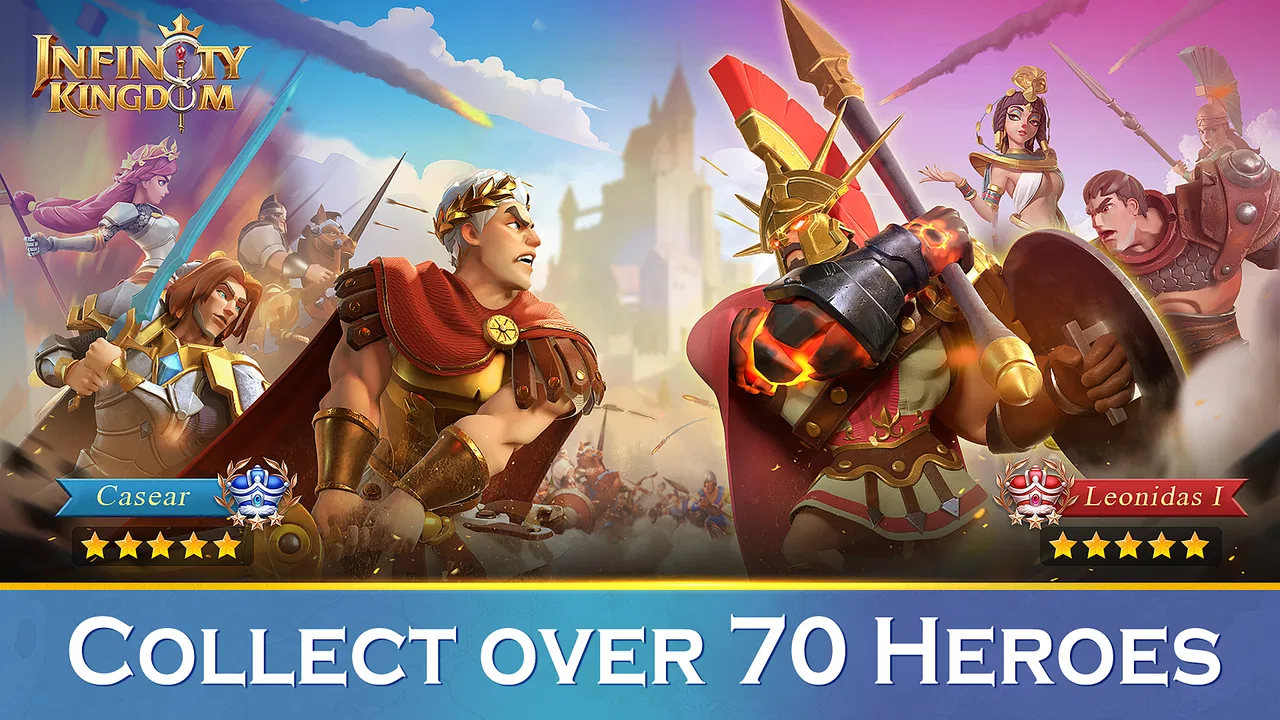
- Diverse characters and skills to explore.
Cons
- In-game purchases can be pricey.
- Requires stable internet connection.
- Some features need time to unlock.
- Can be overwhelming for new players.
- Battery drain on long sessions.

Infinity Kingdom
Gallery